Modern Living Room Designs You’ll Want: Contemporary Styling for Every Home
A modern living room is not a showroom and it is not a test of how little furniture you can own. The best contemporary rooms feel calm because every piece has a job, the colors are restful, and the textures do the talking that clutter usually does.
Whether you are starting from an empty apartment or editing a room you already have, the same principles apply. Build a quiet base, choose lower, cleaner lined furniture, add one or two strong focal points, and layer in softness so the space invites people to sit down.
These 11 modern living room designs walk through that formula step by step, in the order a real room comes together.
1. Embrace the Power of Neutral Palettes

Modern rooms start with a controlled palette, usually warm white, soft grey, greige and one or two natural wood tones. This quiet base is what lets shapes and textures stand out, and it keeps the room feeling larger and calmer. Test paint on the wall and watch it through the day, because greys can turn blue and whites can turn yellow under different light. Carry the palette through the big pieces first, sofa, rug and curtains, then repeat one accent shade in small doses. If a neutral room feels flat, the fix is rarely more color. It is more contrast between light and mid tones, which the later ideas in this guide will add.
2. Incorporate Multi-Textured Layering

Texture is what stops a clean lined room from feeling cold. The rule is to mix at least three finishes within arm’s reach of the sofa: something smooth like leather or polished wood, something soft like a knit throw or boucle cushion, and something rough or woven like jute, rattan or raw linen. Keep the colors close in tone so the variety feels rich rather than busy. Work in odd numbers, three cushions, one throw, one woven basket, and touch everything before you buy when you can. A modern room is experienced as much by hand as by eye, and layered texture is also what makes simple, inexpensive pieces feel considered.
3. Opt for Low-Profile Furniture

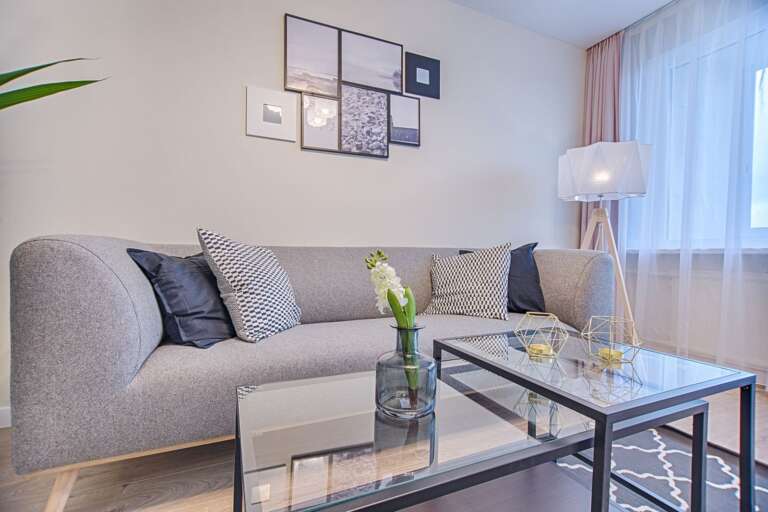
Low, horizontal furniture is a signature of contemporary design because it opens up sight lines and makes ceilings feel higher. Choose a sofa with a low back and slim legs, a coffee table that sits well below the seat height, and media storage that runs long rather than tall. In a small room this matters even more, since bulky high backed pieces cut the space into pieces. Check proportions before buying: the coffee table should be about two thirds the length of the sofa, and side tables should sit level with the sofa arms. If replacing furniture is not an option, removing tall bookcases and lowering art can borrow much of the same effect.
4. Make a Statement with Oversized Art

One big piece of art does more for a modern room than a dozen small frames. A single oversized canvas or framed print above the sofa anchors the seating area, sets the color story and instantly looks intentional. As a guide, the piece should span about two thirds of the sofa’s width and hang with its center near eye level when standing, lower than most people first place it. Abstract and photographic works suit the style best, but a blown up family photo or a textile hanging works too. Keep the frame simple, thin and in one finish. This is the one place to spend a little more, because the art will carry the whole wall.
5. Bring the Outdoors In with Biophilic Design

Straight lines need something alive to soften them. Biophilic design simply means building nature into the room: leafy plants, natural materials and as much daylight as you can keep. One tall plant in the corner, an olive tree, a fiddle leaf fig or a hardy monstera, adds height and organic shape where furniture cannot. Group smaller plants at different heights on a stand or shelf rather than scattering single pots around the floor. Pair the greenery with wood, stone and linen so the room feels grown rather than decorated. If your light is poor, choose pothos, snake plants and ZZ plants, which forgive both shade and missed watering.
6. Use Architectural Lighting as Decor

In a modern room, lighting is the jewelry. An arched floor lamp, a globe pendant or a linear sconce works as functional sculpture, giving the space an artistic note even when switched off. Plan light in layers: one overhead source on a dimmer, a floor or table lamp for reading, and something low and warm for the evening. Stick to one metal finish across fixtures so the room feels composed, and put bulbs in the same warm temperature everywhere. Renters can play too, with plug in sconces and cord covers. Where a fixture lands matters: center pendants over the coffee table zone, not the room, so the light crowns the seating.
7. Define Zones with Large Area Rugs

In open plan homes, a rug is a room without walls. A large area rug under the seating group tells everyone, including your eye, where the living room begins and ends. Size is the part people get wrong. The rug should reach at least under the front legs of the sofa and chairs, and bigger is almost always better. Choose low pile in a tone close to your palette, with a subtle pattern or border if you want definition without noise. Anchor the edges with furniture so corners do not curl, and use a rug pad to stop sliding and add softness underfoot. In a small room, a rug wall to wall under the group can make the space feel bigger, not smaller.
8. Integrated Smart Technology

Modern luxury is mostly invisible. The technology in a contemporary living room should be felt, not seen: a television that sits flush or shows art when idle, speakers tucked onto shelves, charging cables routed through one drawer, and shades that close at the touch of a button. Start with the clutter you can hide today. Corral remotes in one box or drawer, run cords inside cable channels painted to match the wall, and give every charger a single home. Then add upgrades in order of daily impact: smart bulbs or switches for the lighting layers, a streaming device hidden behind the screen, and blackout or sheer motorized blinds if the budget stretches.
9. Add Contrast with Black Accents

A pale room without contrast can drift into bland. Small doses of black give the eye places to land and make everything else look crisper. The key word is small: picture frames, a thin legged side table, a floor lamp stem, cabinet handles or the frame of a mirror. Repeat the black in at least three spots around the room so it reads as a decision, not an accident. Keep the shapes slim and the finish matte, which feels current and avoids glare. If black feels harsh in your light, deep charcoal or dark bronze gives nearly the same grounding effect with a softer edge, and pairs well with warm woods.
10. Curated Minimalist Shelving

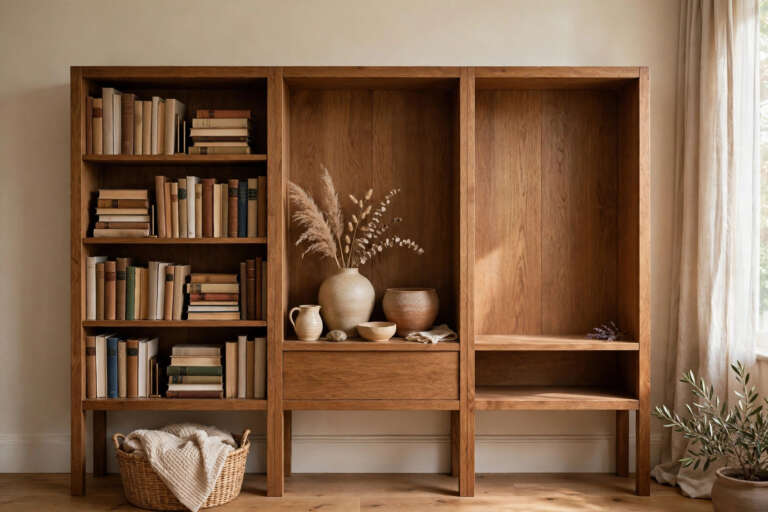
Modern shelving is about what you leave out. Full, packed shelves pull a room back toward clutter, so edit to a few groups: a short stack of books laid flat, one ceramic piece, something personal like a framed photo or a travel find, then empty space. Work in groups of three and leave at least a third of each shelf bare, which gives your eyes rest and lets the chosen objects feel like a gallery. Store the overflow in closed cabinets or baskets below. Rotate pieces seasonally instead of adding more, and keep everyday items like remotes and chargers in one lidded box on the lowest shelf, handy but out of sight.
11. Sculptural Coffee Table Styling

The coffee table is the closest styling surface to where everyone sits, so it deserves the final edit. Start with a tray to hold the arrangement together, then build three elements: something tall like a candle or small vase, something horizontal like one or two large books, and something organic like a small bowl, beads or a tiny plant. Leave at least half the table empty for mugs, feet and real life. Choose one sculptural piece if your table is plain, a curved bowl or an unusual object, and let it be the art of the seating area. When guests come, the whole arrangement lifts away in one trip, which is exactly the point.
Conclusion
A modern living room comes together in layers: a calm palette, real texture, lower furniture, one big focal point and light that flatters the room after dark. You do not need to buy it all at once. Edit first, fix the rug size and the art, hide the cables, and add plants and contrast where the room asks for them. Contemporary styling works because it is honest about how you live, so keep surfaces partly empty and every object earning its place. Build it slowly in that order, and the room will feel current for years, not just for one season.
Frequently Asked Questions
What is the difference between modern and contemporary style?
Modern style refers to a specific design movement with clean lines and simple forms, while contemporary means whatever is current right now. In practice, today’s contemporary living rooms borrow modern’s clean base and soften it with warmer colors and more texture, which is the mix this guide uses.
How do I make a modern living room feel warm, not stark?
Layer texture, choose warm whites instead of blue whites, add wood tones, and use warm bulbs on dimmers. A rug that is big enough and a few soft furnishings in natural fibers will do more for warmth than any paint change.
What colors work best for a modern living room?
Warm white, soft grey, greige and pale oak form the safest base. Add depth with one accent family, such as olive, rust, navy or black in small doses, repeated in art, cushions and one or two accessories.
Can I mix modern furniture with older pieces?
Yes, and the mix often looks better than a full matching set. Keep the older piece as the character item, repeat its wood tone or color once more in the room, and let the cleaner lined modern pieces carry the rest of the space.