20 Small Laundry Room Ideas You’ll Love: Maximize Your Space
A small laundry room does not fail because of its size. It fails because everything in it competes for the same few feet of floor. The fix is not a bigger room. It is using the walls, the door, the gaps and even the machines themselves as storage and workspace.
These twenty small laundry room ideas work through a tiny room from the machines outward, and almost every one of them fits in a weekend. Pick the five that solve your worst problems first, and let the rest follow as time and budget allow.
1: Install a Countertop Over Front-Loaders

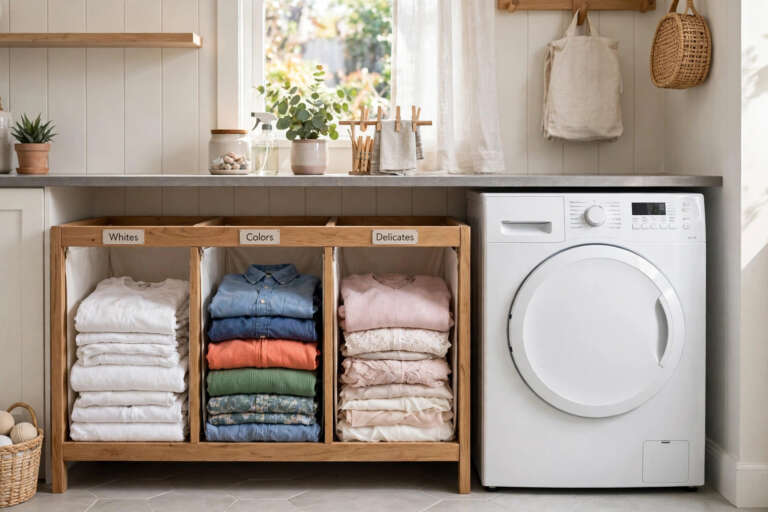
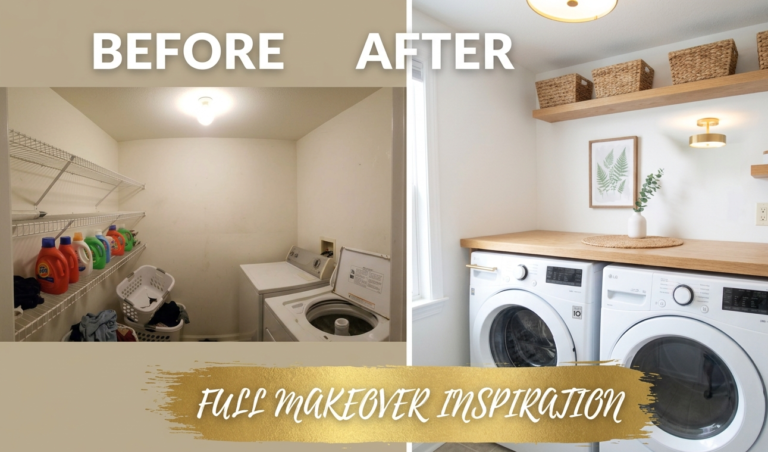
Side by side front loaders leave their tops wasted, and small items vanish down the gap behind them. One continuous countertop fixes both problems at once and gives you the folding surface a tiny room never has. Butcher block, sealed plywood or a stone look laminate all work. Fold straight from the dryer onto the counter and laundry stops migrating to beds and sofas around the house.
2: Floating Open Shelving

The wall above the machines is the easiest storage win in the room. Two floating shelves hold detergent, jars of supplies and a basket of cloths exactly where you stand to load. Keep everyday items on the lowest shelf, within comfortable reach, and lighter or prettier things above. Leave a little empty space on each shelf so it reads as styled storage rather than a stockroom.
3: Slim Slide-Out Utility Cart

That awkward six inch gap beside or between the machines is made for a slim rolling cart. Tiered carts on casters slide out to reveal stain removers, dryer sheets, pegs and spare sponges, then disappear again. Measure the gap carefully before ordering, including baseboards, and choose a cart slightly narrower than the space so it rolls freely.
4: Wall-Mounted Fold-Down Drying Rack

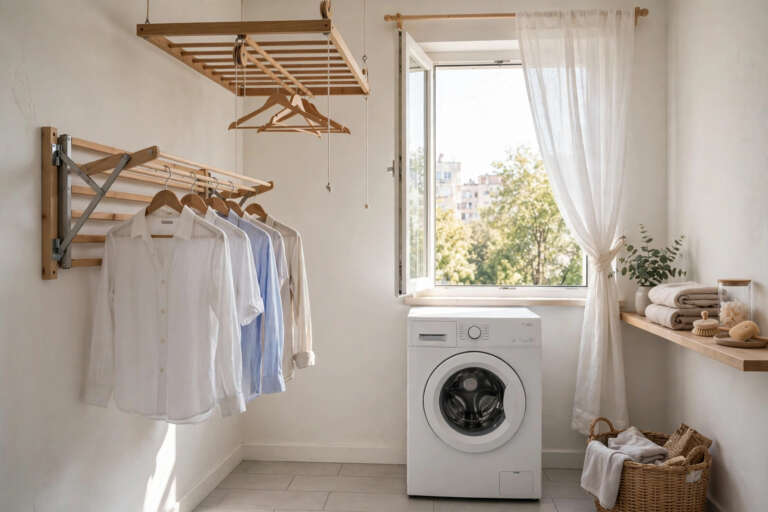
A standing clothes horse consumes the entire floor of a small laundry room. A wall mounted rack folds flat when it is empty and pulls down only for the hours your delicates need it. Mount it above the sink or over the counter so drips fall somewhere sensible, and fix it into studs, because wet clothes are far heavier than the rack itself suggests.
5: Uniform Woven Baskets

Matching baskets are the fastest way to make open storage look intentional. Use them to sort laundry by person or by wash type, to hide the visual mess of packets and bottles, and to carry loads between rooms. Uniform sizes stack and line up neatly, and the natural texture warms up a room full of hard white surfaces. Label them if your household sorts with more enthusiasm than accuracy.
6: Over-the-Door Organizers

The back of the door is a full panel of storage most laundry rooms ignore. A clear pocket organizer holds stain sticks, lint rollers, sewing bits and single socks awaiting partners, all visible at a glance. Hook style racks suit heavier items like the iron or a foldable step stool, and padded hooks stop the whole thing rattling through every spin cycle.
7: Stackable Washer and Dryer

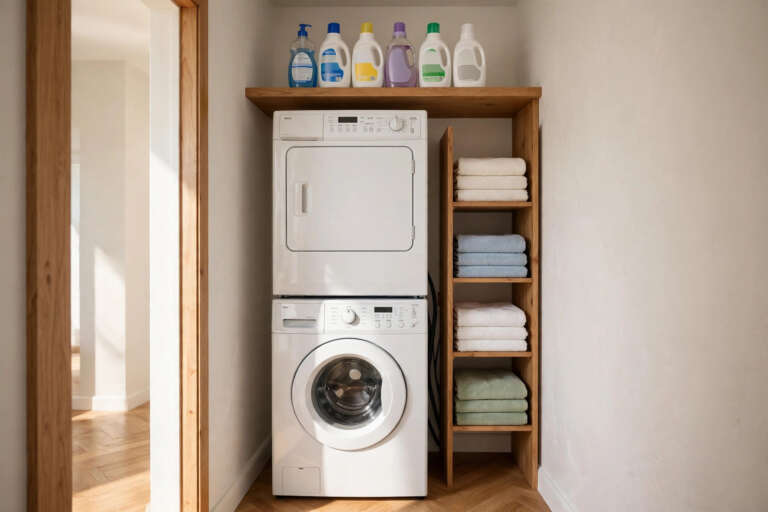
Stacking the machines is the biggest single space decision you can make in a tiny room. It halves the appliance footprint and frees a whole section of floor for cabinetry, a sink or a tall storage unit. Only stack front loaders the manufacturer rates as stackable, use the proper stacking kit, and think honestly about reach. The dryer controls at the top suit most adults, but not everyone.
8: Under-Cabinet LED Lighting

Small laundry rooms are usually dim, and dim rooms feel smaller and dirtier than they are. LED strips under the wall cabinets pour light exactly onto the counter where you sort, fold and hunt for stains. Battery or plug in strips fit in minutes with no electrician, and warm white light flatters pale walls instead of turning them grey. It is a small spend that changes how the whole room feels at night, and it makes pale cabinets look crisp instead of grey.
9: Custom Pegboard Wall

A pegboard turns one flat wall into adjustable storage for everything awkward. Hooks hold scissors, brushes and the lint roller, small shelves carry jars, and the whole layout rearranges in seconds when your routine changes. Paint the board the same color as the wall for a calm built in look, or a contrasting tone if the room needs energy. Pegboards work especially well above a sink or counter, where tools need to live within arm’s reach.
10: Sliding Barn or Pocket Doors

A swinging door steals several square feet of usable floor every time it opens, which in a tiny laundry room can mean the door hits the machines or the person loading them. A sliding barn door runs along the wall instead and gives that space back. A pocket door disappears completely but needs wall surgery, so the barn style is the realistic retrofit.
11: Monochromatic Color Palette

One color family, used everywhere, is the oldest trick for making a small room feel bigger, and it works beautifully here. White or pale grey walls, cabinets and machines blur into each other, so your eye reads one calm volume instead of a patchwork of competing boxes. Break the sameness with texture instead of color. A woven basket, a wood shelf and a plant give the room depth without shrinking it visually.
12: Tension Rod Hanging Station

Shirts and blouses crease less if they go straight onto hangers, and a tension rod gives them a station without any drilling. Span one under a shelf, between cabinets or across an alcove, hang garments as they come out of the wash, and let them dry or wait for ironing there. It costs very little, removes in seconds, and saves the door handles and shower rails currently doing this job badly.
13: Magnetic Side-Mounted Lint Bin

Lint, tissues and pocket debris are tiny, but they are the things that end up on the floor. A small bin that magnets onto the side of the dryer puts disposal exactly where the lint trap gets cleaned, so the mess never travels. It takes two seconds to fit, holds a surprising amount, and empties straight into the kitchen trash. A small habit upgrade, but the floor stays cleaner for it every single day.
14: Built-In Fold-Out Ironing Board

A full size ironing board is nearly impossible to store in a small laundry room, and dragging one from another room is why ironing piles grow. A fold out board hidden in a shallow wall cabinet or a deep drawer is there in seconds and gone just as fast. The boards are smaller than standard, which is fine for shirts and school uniforms.
15: Decorative “Lost Sock” Station

Every household produces single socks, and every household loses them into drawers and baskets. A small lost sock station, a string with clips, a little board or a labeled basket on the shelf, gives orphans one waiting place where partners eventually turn up. It sounds like a joke and works like a system. Check the station on laundry day, reunite what you can, and clear out the true singles every few months before the collection takes over the wall.
16: Clear Glass Apothecary Jars

Detergent pods, clothespins, dryer balls and scent boosters all arrive in loud, bulky packaging that makes shelves look chaotic. Decanted into clear glass apothecary jars, the same supplies look calm, stack neatly and show you at a glance what is running low. Keep jars on a shelf or counter away from the machine’s vibration edge, and if your home has small children, store pods in a latched container up high instead, since they must stay out of reach.
17: Retractable Clotheslines

A retractable clothesline is drying space that exists only when you need it. The reel mounts on one wall, the line pulls across the room or over the tub, and when the load is dry it winds away to nothing. It handles the overflow that a rack cannot, especially bedding and towels on a big wash day. Fit the receiving hook into solid framing, keep the line clear of the door swing, and you have gained meters of drying from a fitting the size of a soap dish.
18: Chalkboard Cabinet Fronts

Painting one cabinet front, or the inside of a door, with chalkboard paint gives the room a message center that earns its keep. Label what lives behind each door, note which items need stain treatment, keep a running list of supplies to buy, or leave the wash symbols decoded for whoever is learning. It is practical first and charming second. Save it for one surface only, because a whole wall of it quickly feels dark.
19: Floor-to-Ceiling Cabinetry

When floor space is gone, the only direction left is up. A run of floor to ceiling cabinets on one wall can hold the entire backup supply of a household, bulk detergent, spare linens, seasonal items and the cleaning tools that wander the house otherwise. Closed doors keep it all calm. Put daily items at waist to eye level and use the top cabinets for things you fetch twice a year, with a small folding step stool living in the toe kick gap so the height is usable, not theoretical.
20: Elevated Machine Pedestals

Pedestals lift front loaders to a height that saves your back at every load, and the drawers inside them are real storage in space that is otherwise sealed shut. Baskets, towels and less used supplies fit neatly below each machine. Buy the pedestals made for your models so the fit and stability are exact, and level them carefully, because any wobble gets louder at height. For a budget version, a sturdy custom platform with open cubbies gives the height benefit, though without the clean built in look.
Conclusion
Twenty ideas is a menu, not a homework list. Every small laundry room needs the same foundations, a work surface, storage that climbs the walls, a drying solution that folds away, and light good enough to work by. Start with the ideas that fix your daily frustrations, the blocked door, the missing counter, the socks on the floor, and you will feel the room grow before you finish half the list. Measure twice, use the walls honestly, and let the floor stay clear. A small room that works this well stops feeling small at all.
And if you want to go further, start with these sorting station ideas.
This pairs well with our guide to stacked laundry closet ideas.
Also worth a look: drying racks for small laundry spaces.
Frequently Asked Questions
What is the first upgrade I should make in a very small laundry room?
A countertop over side by side machines, or floating shelves if the machines are stacked. Both claim space that is currently wasted and both change how the room works every single wash day. If the door swing is your worst problem, a sliding door jumps the queue, because no storage helps a room you cannot move in.
How can I add storage without any renovation?
Use the non invasive wins. A slim slide out cart in the machine gap, over the door organizers, a tension rod hanging station, a magnetic lint bin and uniform baskets on the machine tops all install in minutes with no drilling. Together they can add the practical equivalent of a small cabinet.
Is stacking the washer and dryer worth it in a tiny room?
Usually yes. Stacking frees an entire machine sized footprint, which becomes cabinetry, a sink or sorting space. The trade offs are reach and losing the folding counter on top, so stack when floor space is the crisis, and keep machines side by side when counter space matters more to your routine.
How do I keep a small laundry room from smelling damp?
Airflow and dry textiles are the answer. Run the fan or crack a window after wash day, leave the washer door open between loads, dry everything fully before it goes into baskets, and keep a small open box of baking soda near the machines. A room that dries out properly between uses never develops that closed cupboard smell.