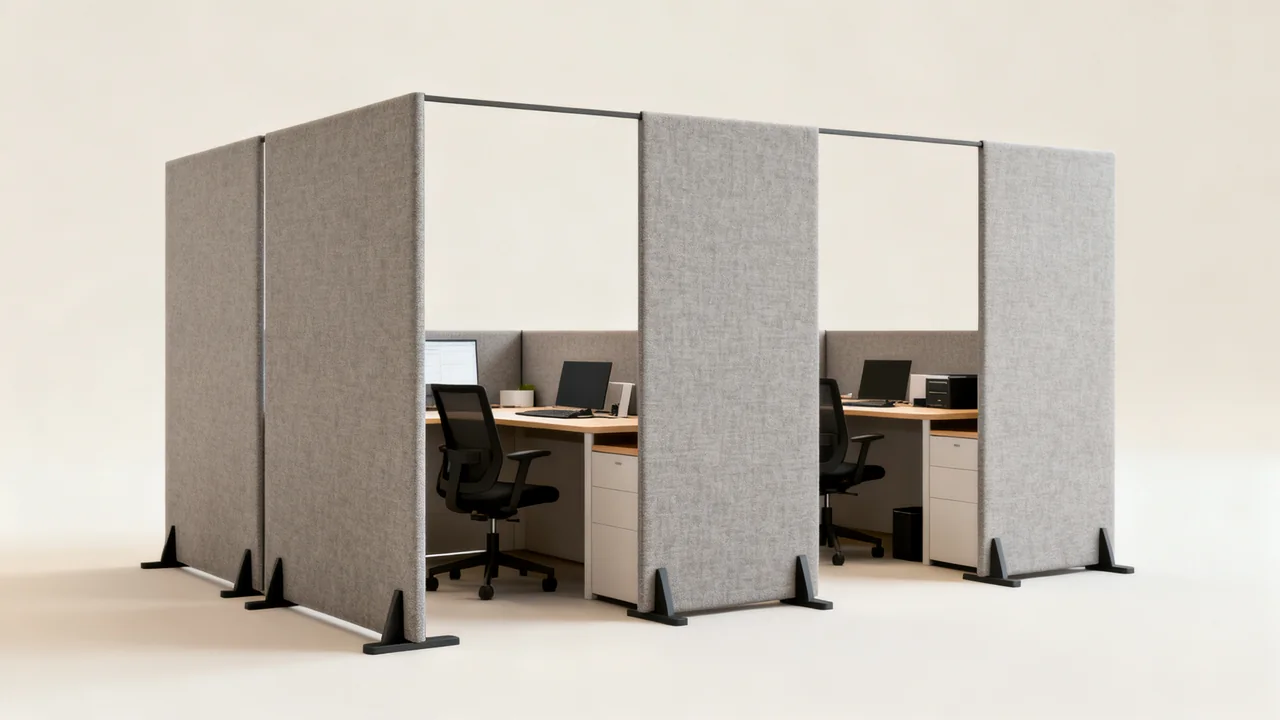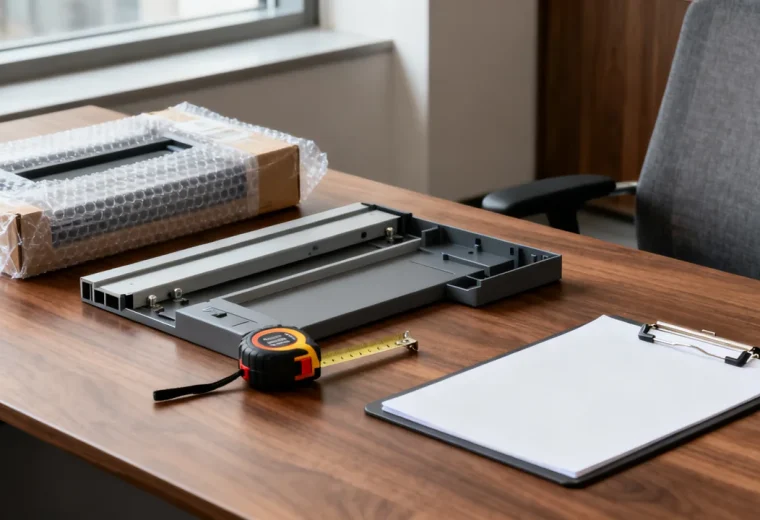
Folding tables can support a room that changes between meetings, training, and other work, but the table must fit both the activity and the handling process. Compare the opened table, folded package, locking mechanism, storage arrangement, and complete equipment load before selecting a model.
Define the actual uses and their frequency
List the recurring setups and what belongs on each table. A writing session, laptop workstation, refreshment area, and equipment station place different demands on the surface and frame. Record how often the room changes and who is expected to move the furniture.
Check user fit with the intended chairs, work items, and layout. Do not assume one table height or width suits every seated task. Leg braces and frame members can reduce usable space even when the top looks large enough.
If the table will become a regular workstation, assess that complete arrangement rather than treating “temporary” as a reason to ignore fit. If an individual or access need requires a particular setup, include it in the selection process before ordering.
Read load and stability information precisely
Obtain the exact model’s load limits and how they apply: distributed load, localized load, permitted equipment, and any restrictions on use or movement. A high total rating does not necessarily authorize a heavy item at one corner or a monitor arm clamped to the edge.
Check whether accessories are approved for the table’s construction. Surface thickness alone does not establish clamp compatibility or local strength. Do not drill, reinforce, or attach equipment using a generic rule that assumes all folding tables share the same frame and core.
Inspect the approved open position and locking mechanism using the manufacturer’s instructions. Consider uneven floors and the intended environment, but do not improvise stabilizers or load tests. Take damaged, unstable, or improperly locking tables out of use pending appropriate service.
| Use requirement | Information to request | Trial focus |
|---|---|---|
| Writing or laptop work | Dimensions, underside clearance, approved use | Actual chair, work items, and user access |
| Equipment support | Load distribution and accessory approval | Supported configuration and stable placement |
| Frequent reconfiguration | Weight, handling method, locks, transport options | The complete approved setup and storage process |
| Compact storage | Folded dimensions, stacking or trolley instructions | Fit through the route and safe access in storage |
Compare surfaces and frames by specification
Plastic, laminate, wood, and metal describe broad material families, not guaranteed performance. Ask about the actual surface construction, edge treatment, care instructions, and relevant product information. Do not infer that every wood table carries more load or that every aluminum frame is less rigid than every steel one.
For writing, test the surface with the intended paper and ordinary permitted use. For equipment, check the approved contact and loading arrangement. For food or refreshments, verify the material’s intended application and care rather than assuming a wipeable surface meets every requirement.
Compare complete table weight and handling guidance, not an average weight associated with a material. A lighter model may be easier to handle but still needs to satisfy the task; a heavier model is not automatically more stable or durable.
Plan folded storage and the transport route
Find out whether the legs fold, the top folds, the table nests, or another mechanism is used. Measure the exact folded package and any approved trolley. Some tables must remain in a particular orientation, and stacking limits or restraints may apply.
Check doorways, corners, lifts, thresholds, and the storage space needed to load and unload. A cupboard with enough floor area may still be unsuitable if the folded table cannot turn through its doorway or if retrieving one item requires unsafe movement of the others.
Follow the manufacturer’s handling instructions and the workplace’s moving procedures. Do not set a universal weight below which one person should carry a table. Shape, grip, route, frequency, and individual capability also matter. Use suitable handling equipment and personnel where needed.
Use an illustrative purchase and layout check
Assume an imaginary office is considering six tables at an illustrative quoted price of $180 each. The table total is $1,080. With a $1,200 equipment budget, $120 remains before delivery, any tax, storage equipment, and other charges. This arithmetic does not establish that an appropriate trolley can be bought with the remainder.
The team tests the proposed meeting and workstation layouts with the actual table dimensions and occupied chairs. It also checks folded storage and the transport route. A statement that six tables fit in a cupboard needs those measurements; it cannot be inferred from the cupboard’s nominal length and width alone.
If the storage system or approved handling process exceeds the budget, the team can reduce quantity, phase the purchase, or compare another model. It should not remove necessary handling provisions merely to preserve the original table count.
Check connections and make setup repeatable
If equipment needs power or data at the tables, plan an appropriate installation with the responsible facilities or technical person. Avoid improvised cable crossings, unapproved clamp-on power accessories, and assumptions that every portable power arrangement is suitable.
Provide a short setup guide based on the exact table: approved opening and locking sequence, inspection points, permitted layout, and storage arrangement. Keep fingers and objects away from moving mechanisms as directed, and do not move loaded tables unless explicitly supported.
Follow specific care instructions for the surface and frame. Do not generalize a cleaning product across every plastic or laminate table. If cleaning occurs near electronics, coordinate safe handling of the equipment and connections using their instructions.
- Define recurring activities and equipment loads.
- Check dimensions, user access, and underside obstructions.
- Verify load distribution and accessory approval.
- Measure the folded package, trolley, and entire route.
- Plan appropriate handling and storage before buying.
- Document setup, inspection, care, and fault reporting.
Have a question or a correction?
Contact the editorial team