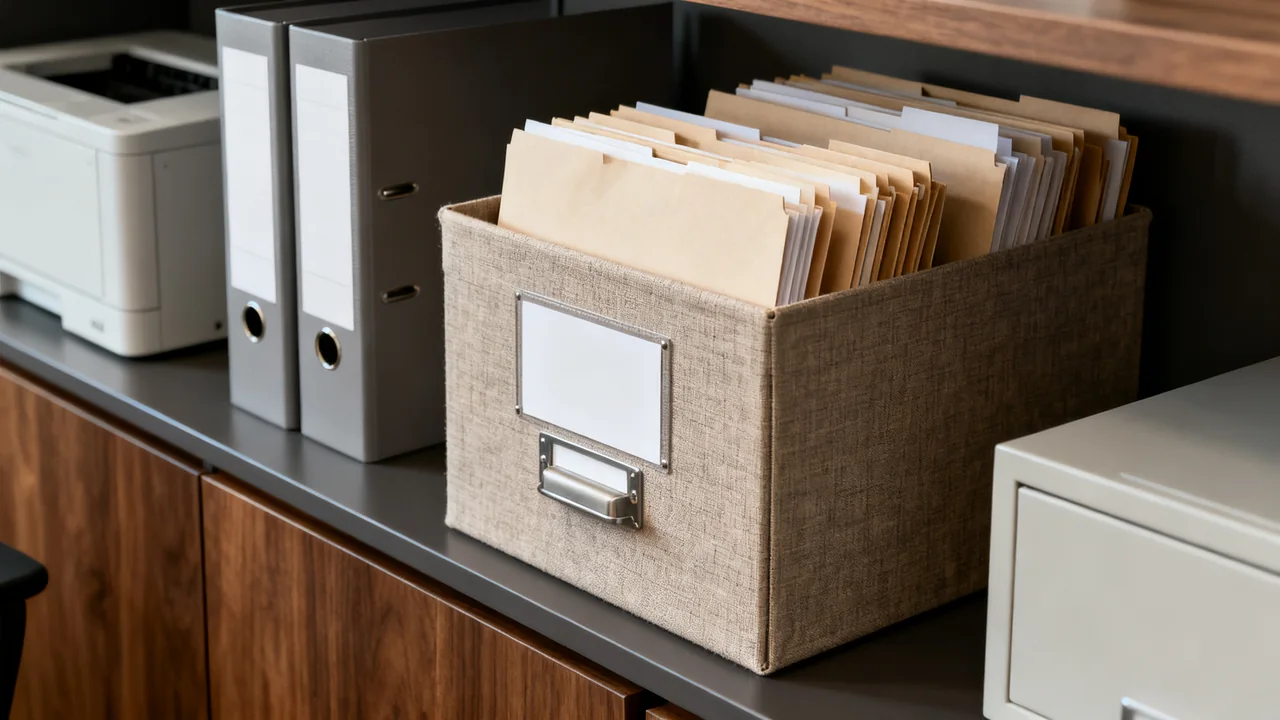
Occasional reference material includes documents you do not need for daily operations, but must retain for audits, historical project lookup, or regulatory recordkeeping. Unlike active files that you pull weekly or monthly, these items may only be accessed infrequently, so their storage requirements prioritize long-term protection and space efficiency over frequent handling. This guide covers how to select file boxes that meet those specific needs, without overspending on features designed for active file use.
First: Audit Your Reference Material’s Specific Attributes
Before evaluating any box options, document the key traits of the material you plan to store, as these will narrow your choices immediately. Start by sorting the reference material into groups by format, sensitivity, and retention period. For each group, note:
- Physical format: Standard letter/legal paper, bound reports, oversized blueprints, digital media (discs, external drives), or mixed formats
- Sensitivity level: Public internal records, confidential personnel or financial data, or proprietary intellectual property
- Required retention timeline: As specified by applicable regulatory rules, internal policies, or permanent/indefinite pending a future decision
- Storage location: Climate-controlled office closet, unheated basement storage, off-site warehouse, or elevated shelves
Skip this step and you may end up with boxes that are too small for oversized materials, insufficiently durable for unconditioned spaces, or overbuilt for materials you only need to retain for a short period.
Core Material and Durability Tradeoffs
Compare the actual box’s construction, intended use, and specifications rather than treating plastic as permanent storage or thicker cardboard as suitable for damp rooms. A water-resistant surface does not protect paper from a poor storage environment.
For material that needs long-term preservation, consider appropriate preservation-quality enclosures. The Library of Congress paper-care guidance recommends supportive acid- and lignin-free enclosures and a stable, suitable environment, avoiding locations with high risk of leaks or environmental extremes. Important or unusual records may need advice from a records or preservation specialist.
For ordinary reference copies, a well-constructed file box may be adequate in a suitable office location. Check handle strength, assembly, lid fit, and stated load or stacking limits. A plastic latch is not proof of waterproofing or secure storage, and a heavy-duty label does not establish an archival lifespan.
Size and Load Capacity Considerations
Occasional reference material is often stored in hard-to-reach areas, so box size directly impacts how easy it is to retrieve and move when you do need access. Avoid over-sizing boxes, as a fully packed legal-size box of paper can be heavy enough to cause strain when lifting from high shelves or deep storage bays.
For most standard paper records, choose a box size that aligns with the volume of material in each of your pre-sorted groups. If you have a measured 15 linear inches of material for a single project, pick a box with 18 to 20 linear inches of internal space to leave room for labeling tabs and easy retrieval of individual folders, rather than forcing material into an undersized box or wasting space with a box that is half full. These figures are for illustrative purposes only; adjust based on your actual measured material volume and manufacturer-listed internal dimensions.
Always check the manufacturer’s listed load capacity before purchasing, especially if you plan to stack boxes. Even heavy-duty corrugated boxes have a maximum stacking weight, and exceeding that can cause lower boxes to collapse, damaging the contents inside.
Illustrative Example: 12-Person Architecture Firm Reference Storage
A hypothetical architecture office separates ordinary reference copies, oversized drawings, and confidential contract records. The responsible records owner supplies the actual retention and access requirements; the buyer does not invent a retention period from the document type.
The buyer measures each format and selects sample boxes that support it without bending. Oversized material receives suitably sized enclosures rather than being folded to fit standard files. A proposed damp basement is rejected as a routine storage solution; a box coating is not treated as a substitute for an appropriate environment.
Confidential records go into approved restricted storage, with a location record and access process. The box itself is only part of that arrangement. The office tries the chosen boxes on the intended shelves before ordering the full quantity.
Access and Security Feature Comparison
Infrequent access changes convenience requirements, but does not remove the need for safe handling, identification, and appropriate security.
| Feature | Best for these use cases | Skip if these apply |
|---|---|---|
| Integrated carry handles | Boxes stored on high shelves or in off-site storage, requiring transport when accessed | Boxes stored on accessible lower shelves, never moved from their storage location |
| Attached hinged lid | Long-term storage, to avoid losing separate lids when boxes are opened rarely | Short-term storage where boxes will be discarded once the retention period ends |
| Lockable latch | An additional closure where useful; not a substitute for approved restricted storage and access control | When an ordinary closure suffices within the approved storage arrangement |
| Built-in label holders | Boxes stored on unlabeled shelves, mixed with other storage materials | Boxes stored in dedicated, clearly labeled storage bays where contents are already identified by bay signage |
Choose features for the actual handling and storage process. Their usefulness depends on where the boxes go and who retrieves them, not a fixed maximum number of features.
Compatibility With Existing Storage Systems
Before purchasing, measure the interior dimensions of your existing storage spaces (shelves, cabinets, storage unit bays) to ensure the boxes you select fit without wasted space. For illustrative example: if you have measured 36-inch wide shelves, three boxes exactly 12 inches wide add up to 36 inches, but that leaves no handling clearance and may not work in practice, but using 13-inch wide boxes will leave you with only two boxes per shelf and 10 inches of unused space per shelf. Adjust these calculations based on your actual measured shelf dimensions and selected box dimensions.
If you use barcodes or QR codes to track storage inventory, select boxes with a flat, untextured surface on the side or top where you can affix scannable barcodes or QR codes. Avoid boxes with heavily textured surfaces or embossed logos that interfere with scanning, as this will add extra work when you need to locate a specific box of records quickly.
If you plan to store boxes on wire shelving, confirm the box base is properly supported and suitable for that shelving. Some basic corrugated boxes have thin, flexible bottoms that may sag over time on wire shelves, so opt for a model with a reinforced bottom for this use case, as confirmed by manufacturer specifications.
Post-Purchase Usability Tips for Occasional Reference
Even the best file box will be frustrating to use if you do not prepare it correctly for low-frequency access. Follow these steps when packing boxes:
- Pack related material together, and label the box with the full date range and content category on two sides and the top, so you can identify it regardless of how it is stacked or placed on shelves.
- Add a single-page inventory list to the inside of the lid, listing every folder or item in the box, so you do not have to dig through all the contents to confirm if a specific document is stored there.
- Leave a small amount of empty space at the top of the box, so you can easily remove and replace folders without tearing paper or bending materials when you do access the box.
- For sensitive material, log the box location and a list of authorized users in your office’s shared records tracker, so only approved staff can retrieve the box when needed. Consult your organization’s information security policy for specific requirements for handling confidential records.
Choose shelf positions using weight, stability, and safe retrieval as well as access frequency. Do not place heavy boxes high merely because they are rarely needed. Use smaller loads or suitable handling assistance where necessary, following the workplace’s handling arrangements and the shelf and box limits.
Actionable Selection Checklist
Use this checklist when evaluating potential file box options to ensure they meet your specific needs:
- Material matches your retention timeline and storage environment, as confirmed by manufacturer product specifications
- Internal dimensions fit your material format with a small amount of extra headspace for easy folder retrieval
- Load capacity supports the total weight of your packed material, plus any stacking weight from boxes stored above, per manufacturer ratings
- Exterior dimensions fit your existing storage shelves or bays with minimal wasted space, based on your pre-purchase measurements of storage areas
- Only includes the access and security features you actually need (no unnecessary add-ons that increase cost without benefit)
- Surface is compatible with your labeling or inventory tracking system
Try a sample with a manageable representative load before ordering in bulk. Check fit, labeling, folder removal, lid clearance, and safe retrieval. Confirm special preservation or records requirements with the responsible person; a general file-box description does not establish compliance with a retention or security policy.
Have a question or a correction?
Contact the editorial team