Furniture samples help compare appearance, texture, and care requirements before a large order. They do not turn an office into a materials laboratory or prove how long a finish will last. Use samples to make a documented selection, and use the supplier’s relevant technical information for performance claims.
Confirm exactly what the sample represents
Match the sample code, material, finish name, color, product range, and revision where applicable to the quotation. Ask whether it represents the final furniture construction or only a surface material. A fabric swatch does not show how seams, padding, and shaping will feel on the finished chair.
For a desk, clarify whether the sample includes the specified substrate, surface finish, and edge treatment. Laminate, veneer, and solid wood are different constructions; a visual finish name such as “oak” does not identify the underlying material.
Ask about expected variation, especially for natural materials and different production batches. Keep the supplier’s explanation with the sample so a later delivery comparison distinguishes permitted variation from a wrong specification.
Compare appearance in the actual room
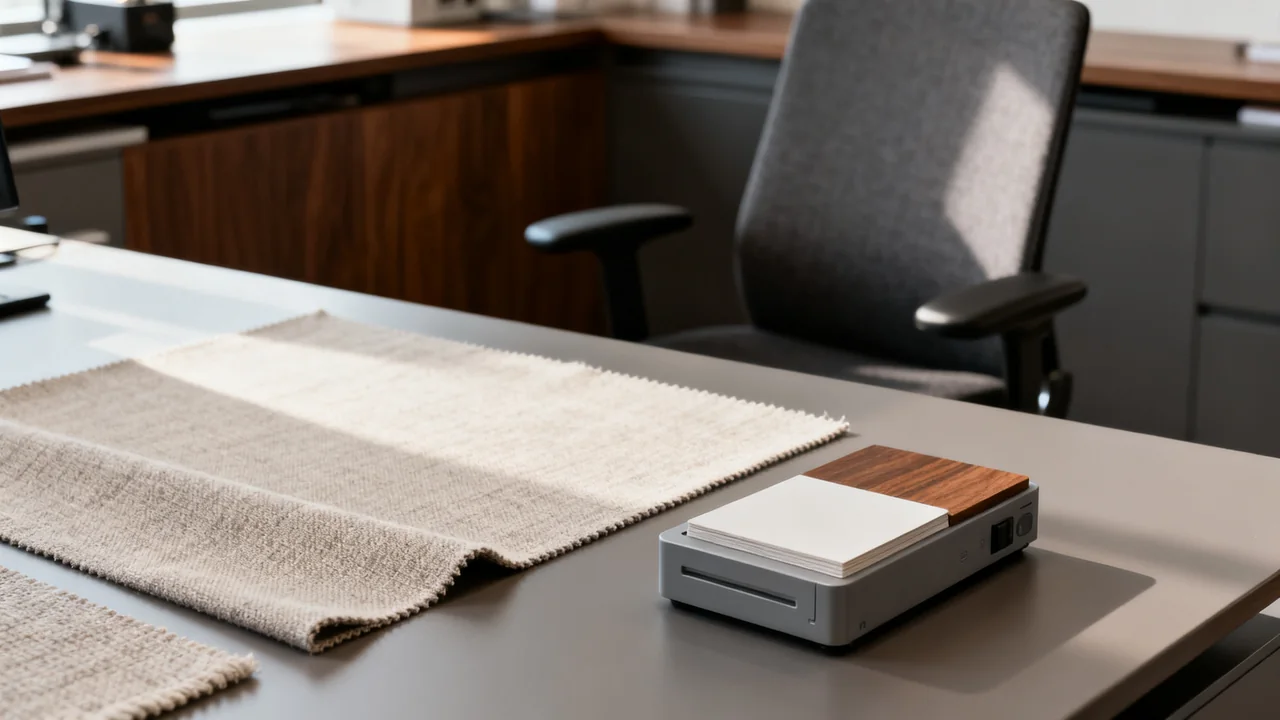
View samples under the lighting in which the furniture will be used, including relevant daylight changes. Place them near existing surfaces and wall colors without assuming a showroom appearance will transfer exactly.
Look at the sample from ordinary seated and standing positions. Gloss and texture can affect reflections, fingerprints, and the visibility of marks. A small sample may underrepresent the visual effect of a large patterned or reflective surface, so request a larger sample or finished-item viewing where that matters.
Use photographs as a record, but retain the physical sample when possible. Camera processing and screens can change apparent color. Label each photograph and sample so alternatives do not become confused during approval.
Evaluate feel and construction without destructive improvised tests
Handle samples as permitted by the supplier. Note texture, edge smoothness, obvious defects, and the feel of surfaces users will contact. For seating, try a representative finished item if comfort and support are part of the decision; loose cloth cannot establish how the full chair fits a person.
Do not use a cotton-swab rub count to predict upholstery life, a paper-attraction experiment to certify static behavior, or a pen scrape to establish a finish’s scratch resistance. Those improvised methods lack controlled conditions and can damage a sample without producing a dependable comparison.
Likewise, do not apply hot mugs, arbitrary weights, or chemicals as unofficial tests. If a performance demonstration is useful, agree a suitable method with the supplier and clarify what it can and cannot show. Structural furniture capacity cannot be inferred by pressing on a small finish sample.
| Selection question | Useful sample observation | Additional evidence needed |
|---|---|---|
| Does the color suit the room? | Side-by-side viewing under actual lighting | Supplier explanation of expected variation |
| Does the surface feel appropriate? | Permitted handling and finished-item trial | Exact material and construction specification |
| Can the office care for it? | Review of the required care process | Manufacturer’s approved cleaning guidance |
| Will it tolerate the intended use? | Identification of likely contact and wear points | Relevant product test information and stated limitations |
| Does the delivered item match? | Retained labeled approval sample | Final order codes and agreed acceptance terms |
Review care and performance documents
Obtain the exact upholstery or finish care instructions. Compare approved products and methods with the cleaning team’s actual process. If they conflict, resolve the process or select another material. A discreet patch test does not authorize a chemical the manufacturer excludes.
Ask for relevant test information where durability or resistance is a purchasing requirement. Confirm that it applies to the material and finish being ordered and understand the stated test conditions. A test result is not automatically a prediction of years of use in your office.
Keep cleaning, stain resistance, sanitizing, and disinfecting claims distinct. A material being easy to wipe does not establish that a chosen disinfectant is compatible or that the cleaning process achieves a specific result. Avoid importing claims from a similar product line.
Work through an illustrative sample comparison
Assume an imaginary office is ordering six chairs and six desks and has two approved upholstery candidates and two desk finishes. These quantities describe the example only. The team labels every sample with its exact order code and compares them under the room’s lighting.
One upholstery sample matches the decor more closely, while the other has a care procedure that better fits the office’s approved cleaning arrangements. The team requests clarification before deciding; it does not stain both samples and convert the result into a predicted service life.
For the desk finishes, a full-size sample desk reveals reflections that were hard to judge from a small chip. The team records the appearance tradeoff alongside care requirements and quoted costs. The decision remains tied to those observations, without inventing a price premium or additional years of durability.
Turn approval into an unambiguous order
Record the selected codes, who approved them, any accepted variation, and the documents reviewed. Include finish and upholstery identifiers on the final order rather than relying on a descriptive phrase from an email.
Retain samples as agreed with the supplier for delivery comparison. Note if a sample must be returned and keep an alternative reference. Confirm cancellation, change, and return terms before ordering customized materials.
At delivery, compare identity and finish against the approved specification under suitable lighting. Report discrepancies using the agreed process. Do not accept an unapproved substitute solely because it has a similar color name.
- Verify the sample’s exact material and order code.
- Inspect appearance in the actual environment.
- Use finished-item trials for construction and user fit.
- Avoid improvised destructive or predictive tests.
- Check exact care instructions and relevant technical evidence.
- Keep the approval record with the final purchase order.
Have a question or a correction?
Contact the editorial team