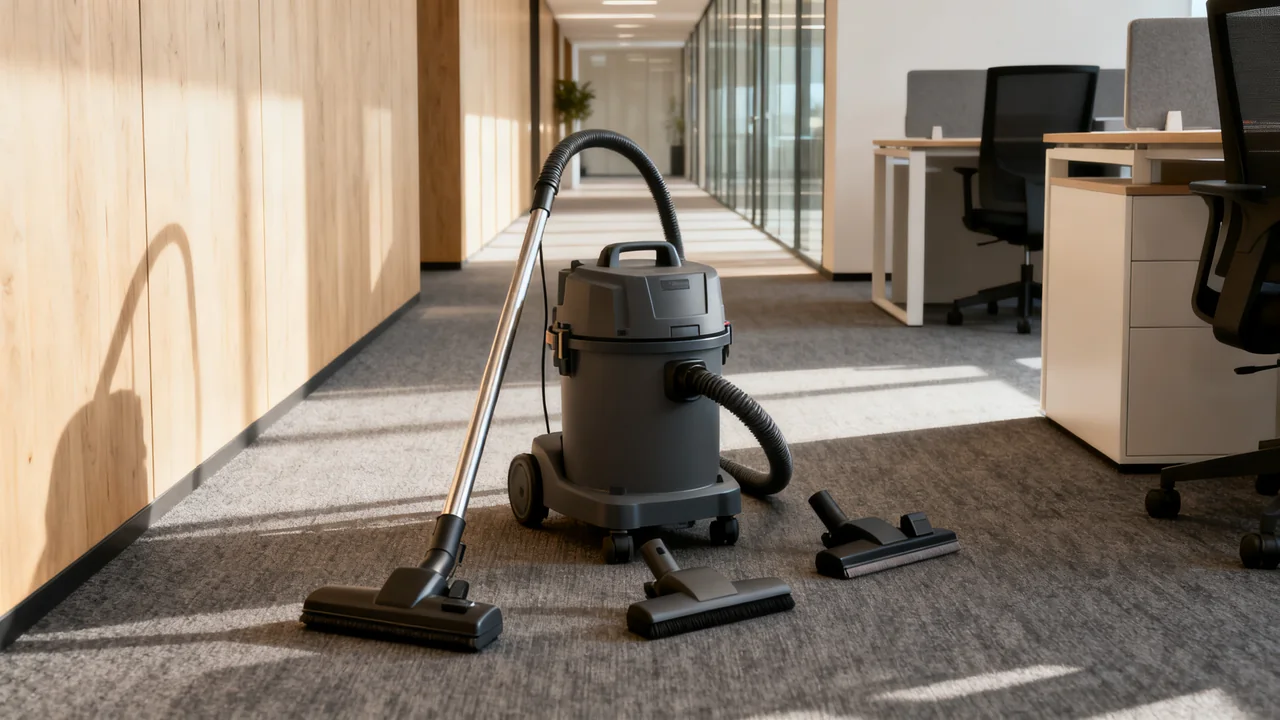
Choosing an office vacuum starts with the floor, cleaning route and person using it. A model that fits a small carpeted room may be awkward in a workplace with hard floors, meeting tables and stairs. Compare the actual equipment and its approved uses; neither a “commercial” label nor a particular body style guarantees that it can collect every type of office debris.
Map the Cleaning Job Before Comparing Models
List each floor finish and the areas that need regular cleaning. Note rugs, thresholds, narrow spaces under furniture and any stairs. Ask the flooring supplier which heads or brush actions are appropriate, especially for finishes that can mark easily. Identify places that cannot be reached without moving furniture or disturbing cables.
Record when cleaning takes place and who does it. Noise during a call, carrying equipment between floors and access to storage can matter more than a small difference in a headline power rating. Measure the storage space with the hose, tools, charger and spare supplies included, not just the vacuum body.
Describe the debris accurately. Ordinary dry dust and crumbs differ from liquids, fine construction dust, toner, sharp objects or hazardous material. A general office vacuum should not be used for those special materials unless the manufacturer expressly rates it for the application. Pick up loose items by an appropriate safe method before vacuuming so they are not drawn into the machine.
Compare Body Styles Without Assuming a Winner
| Style | Reason to try it | Question to test on site |
|---|---|---|
| Canister | A separate head may reach around furniture conveniently | Does the body follow without snagging the hose or striking furniture? |
| Upright | An integrated head can suit open carpeted areas | Can the user reach the needed edges and change to approved hard-floor cleaning? |
| Stick | Compact storage and easy access may suit short cleaning tasks | Are runtime, collection capacity and intended duty adequate for the actual route? |
| Backpack | A carried unit may leave less equipment moving across the floor | Is the harness comfortable and appropriate for every intended user and route? |
Weight, noise, reach and capacity vary within each category. Avoid buying from a square-footage table that assigns a body style to every office of a given size. Two spaces with the same area can have very different obstacles and cleaning times.
If a supplier offers a demonstration, include the regular cleaner. Test the difficult corner, storage doorway and flooring transition rather than only an open patch of carpet. Record the attachment used, power setting and any compromises so competing models receive the same assessment.
Ask Specific Questions About Filtration and Collection
Compare the manufacturer’s filtration specification for the complete machine, including how the filter is fitted and maintained. A filter name alone does not describe all possible leakage paths or establish a health outcome for occupants. If facilities has a filtration requirement, ask the supplier for documentation showing that the proposed model meets it.
For a bagged model, check the correct bag reference, availability, replacement procedure and fill indicator. For a bagless model, test how the container is removed and emptied using the manufacturer’s instructions and the workplace’s waste arrangements. Choose a process the operator can complete without unnecessary dust release or handling.
Do not assume that every filter can be washed. Identify which filters are washable, which are replaceable and how dryness is confirmed before refitting. Store spare approved supplies where the cleaner can find them. A machine that is frequently used with the wrong bag or neglected filter is a poor operational fit even if its initial specification looks attractive.
Check Reach, Power and Battery Claims
For corded equipment, map suitable outlets and the cleaning route. Check the supplied cord’s reach without creating a trip path across an occupied passage or pulling the cable taut. A universal minimum cord length is not a substitute for a route check. Do not plan on improvised extension arrangements; use only arrangements approved by the equipment instructions and workplace electrical policy.
For a cordless model, compare runtime under the intended head and setting. A maximum advertised figure may represent a different operating mode. Include time to recharge, battery availability and whether battery changes are permitted and practical for the operator. If a spare battery is proposed, obtain a quote for the correct approved battery and charger.
Ask whether the intended workplace use is covered by the warranty and service terms. Confirm where repairs are performed and what happens while the vacuum is unavailable. These questions are more useful than assuming every domestic model is unsuitable or every commercial model has the same duty rating.
Illustrative Example: A Mixed-Floor Office
Consider a hypothetical 1,800-square-foot office with carpeted desk areas, a vinyl breakroom and a small storage cupboard. Cleaning occurs after staff leave, and the cleaner stays on one floor. These facts create a comparison brief; they do not prove that an upright or canister is automatically best.
The team shortlists two models with approved heads for the actual flooring. They ask the supplier to demonstrate reaching under desks, changing floor modes and storing each machine with its tools. They record the route completed, outlet changes or remaining battery, emptying process and noise as observed by the cleaner.
If one model is quicker on open carpet but awkward under tables, the decision can be made against how much of the weekly work occurs in each area. If neither fits safely in the cupboard, storage has to change or a different model is needed. No purchase should depend on assumed coverage from an untested cord length.
Compare Ongoing Costs Using Quotes
Build a simple worksheet with purchase price, required attachments, bags, filters, batteries where applicable, and service charges. Enter current supplier quotes and mark any estimated replacement quantity as an assumption. Use the maintenance instructions and observed workload to refine it after a trial.
Compare bagged and bagless options on the full workflow rather than declaring one cheaper after a fixed number of years. Emptying time, supply availability and operator preference can change the outcome. An included attachment only has value if it is approved for the surface and useful on the route.
Confirm part references and lead times before purchase. Keep the manual and supplier contact with the equipment record. Electrical repairs and damaged power cords should be handled through the appropriate service provider, not by an improvised office repair.
Purchase and Handover Checklist
- The model and attachments suit the actual floor finishes and intended debris.
- The operator has tried the weight, controls, reach and storage arrangement.
- Filtration documentation meets any workplace requirement.
- Cord routing or battery runtime is practical for the cleaning route.
- Correct consumables, maintenance instructions and service contacts are available.
- Staff know to stop using damaged equipment and report the defect.
After delivery, repeat the acceptance check with the supplied equipment rather than assuming it exactly matches a showroom example. Record the model, serial number, included parts and any missing items. A short handover gives the cleaner a clear route for reporting problems and helps the office avoid buying a second machine simply because the first was never set up appropriately.
Have a question or a correction?
Contact the editorial team