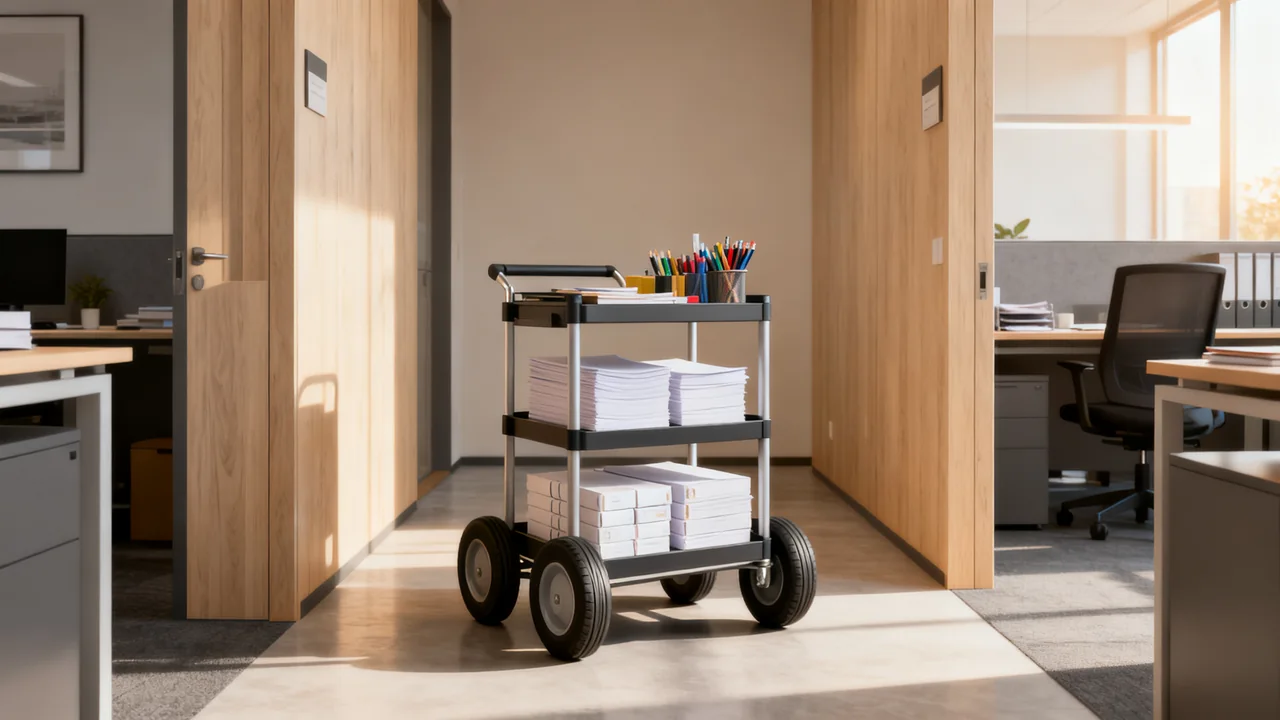
Office supply carts simplify restocking desk stationery, meeting room amenities, printer consumables, and breakroom goods across multi-room workspaces. A suitable model can make routine transport easier, but capacity, route, load stability, and the user’s ability to control it all need checking. This guide focuses specifically on use cases for moving supplies between rooms, separate from stationary storage solutions, kitchen carts, or heavy equipment transporters.
Map Your Typical Transport Loads First
Before evaluating cart specs, document the full range of items you regularly move between rooms to define minimum capacity requirements. List the heaviest single item you may carry, as well as the largest volume of goods you move in a single trip, to avoid selecting a cart that is too small or has a weight limit that is too low. Common loads include case packs of copy paper, boxes of pens and sticky notes, breakroom snack and beverage cases, cleaning supplies for shared spaces, and spare peripherals like keyboards or mice.
Note fragile items, liquids, and small loose supplies separately. Use suitable closed containers and secure loads according to the cart maker’s directions. A raised shelf edge is not automatically a spill-containment system, and open liquid containers should not be the default transport method. Follow product-specific separation and containment instructions.
Measure Doorways, Hallways, and Turn Points
Cart maneuverability depends on its geometry, wheels, load, and the route, so take physical measurements before shopping to avoid purchasing a model that cannot navigate your space. Measure the width of every doorway the cart will pass through, including closet doors, supply room entries, and meeting room doors, and account for any doorstops, trim, or wall-mounted fixtures that narrow the clearance. Measure the width of the narrowest hallway the cart will use, as well as the space available at corners where you will need to turn the cart 90 or 180 degrees.
Record stairs, gradients, thresholds, and uneven surfaces as route constraints. A normal office cart should not be taken onto stairs. If the route has no suitable level or lift access, obtain a properly assessed transport method and equipment intended for that route; a product labeled “stair climbing” does not establish that an operator can safely handle a particular load.
Illustrative Example
A hypothetical office moves paper and stationery from a supply room to two meeting rooms on the same floor. The buyer measures the doors and turning space, checks the floors and thresholds, and weighs a representative load. Candidate carts are compared against both total and per-shelf limits.
The office arranges a trial with manageable loads and the people who will use the cart. It checks steering, stopping, visibility over the load, and where the cart can be parked without obstructing access. If a larger carton would block the user’s view or make control difficult, it is divided into smaller suitable loads rather than treated as acceptable simply because it is below a stated weight limit.
This example illustrates a selection process, not a measured reduction in trips, injury risk, or restocking time.
Evaluate Core Frame and Surface Features
Compare the specific construction, capacity, and intended use. Plastic and metal carts vary considerably; material alone does not establish strength, durability, or ease of pushing. Check total load capacity, per-shelf limits, empty weight, handle design, and any restrictions on use.
For small supplies, use suitable bins or shelves with retaining features. Check whether shelves can be adjusted and whether changing their position affects capacity or stability. Keep loads distributed as instructed by the manufacturer and avoid stacking items where they block the user’s view.
Compare Wheel and Maneuverability Options
Wheel suitability depends on the actual floor, load, diameter, tread, bearings, and cart geometry. Ask the supplier about the intended route rather than assuming that all rubber wheels are quiet or all plastic wheels mark floors. Confirm any non-marking claim against the flooring requirements.
| Configuration | Question for a trial |
|---|---|
| All swivel casters | Can users steer and hold a straight path comfortably with the intended load? |
| Fixed and swivel casters | Is there enough room to turn and reposition the cart? |
| Braked casters | Which movement does the brake restrain, and is it appropriate for the parking location? |
| Wheels for uneven surfaces | Is the complete cart rated for the route, and can users maintain control? |
Test on the actual route where possible. Do not use a parking brake as a substitute for a suitable level parking location, and follow any restrictions on ramps and thresholds.
Assess Optional Features for Specific Workflows
Many supply carts include optional features that add utility for specific office use cases, though each adds cost and may increase the cart’s overall footprint. Evaluate which features align with your regular transport needs to avoid paying for unnecessary extras:
- Built-in storage bins or drawers: Useful for transporting small, loose items like paper clips, USB drives, or individual snack packets without requiring separate storage containers. Bins may be fixed or removable, allowing you to load supplies directly into the bin in the supply closet and place it directly on a desk or meeting room shelf without unloading individual items.
- Handle height adjustment: Important if multiple team members of different heights will use the cart regularly, to reduce strain from pushing or pulling at an awkward height. A fixed handle still needs to suit every intended user.
- Locking wheels: Helpful if you will use the cart as a temporary supply station during team onboarding, meeting setup, or office restocks, subject to the manufacturer’s directions; park in a suitable level location and check brake operation.
- Spill containment trays: Designed to catch leaks from liquid supplies like cleaning products, breakroom beverages, or hand soap, preventing damage to floors or other items in the load. These trays are often removable for easy cleaning if a spill occurs.
Weigh Tradeoffs for Multi-Use Carts
Many small workplaces use a single cart for multiple purposes beyond supply transport, such as moving office furniture, transporting event supplies, or hauling waste to recycling bins. If you plan to use your cart for multiple tasks, weigh these common tradeoffs to find a model that fits all your needs without compromising core supply transport functionality:
A smaller cart may be easier to store, but compare its actual rated capacity and usable surface area, requiring more trips for large supply restocks. A larger cart may accommodate more supplies within its ratings, but may be harder to maneuver in narrow hallways and may take up more storage space when not in use.
A cart with a flat, open surface is more versatile for moving large, irregular items like boxes of office equipment or folding tables, but will not contain loose or small supply items without adding separate storage bins. A cart with built-in shelves and bins is optimized for supply transport, but may not accommodate large, irregular items when needed.
Post-Purchase Setup and Usage Checklist
Once you have selected a cart, take these steps to ensure it works effectively for your team:
- Assemble the cart according to the manufacturer’s instructions, and verify all wheels turn smoothly and handles are secured tightly before loading any supplies.
- Trial the cart with a manageable representative load within all rated limits, increasing only where appropriate under the workplace’s normal handling arrangements. Confirm route clearance, control, visibility, and parking.
- Create a designated storage spot for the cart, preferably near the supply closet or main loading area, to ensure it is always available when needed and does not block walkways when not in use.
- Establish a simple cleaning routine: Wipe down surfaces after transporting messy or liquid items, per the manufacturer’s approved cleaning method, and check wheels periodically for debris that could cause jams or scuffs.
- Add a label to the cart indicating it is designated for supply transport, to avoid it being permanently repurposed for other tasks like moving trash or furniture that could damage surfaces or reduce its suitability for supply use.
Have a question or a correction?
Contact the editorial team