When sourcing used office furniture, cost savings often come with hidden risks: unreported structural damage, worn components that fail soon after purchase, or upholstery that cannot be properly sanitized for shared use. This checklist focuses exclusively on condition evaluation, separate from layout planning, product selection, or cost comparison tasks covered in other resources. Use the identified model’s instructions and obtain qualified help for uncertain damage or repairs. An informal condition check is not a certification of safety, load capacity, or remaining life.
Pre-Purchase Pre-Work: Gather Reference Specs First
Before you inspect any used piece, pull the exact manufacturer’s product page for the model in question, if you can identify it from product labels or seller photos. This document will confirm the original features, weight limits, adjustability ranges, and component parts so you can spot missing or modified pieces during inspection. If the model cannot be identified, treat its specifications, parts availability, and care requirements as unverified; a visual guess at the material does not resolve those questions.
For shared use furniture, confirm your workplace’s policies for upholstery sanitization and furniture safety checks before committing to a purchase. Some workplaces require professional sanitization for all used soft surfaces, while others restrict used furniture in food prep or client-facing areas entirely. Align your purchase with these policies to avoid post-purchase rejections.
Structural Integrity Check for Seating, Desks, and Storage
Inspect unloaded furniture first. Look for cracked or bent components, loose connections, missing fasteners, damaged feet, water damage, and signs of improvised modification. Compare the installed components with the model documentation where available. Do not sit on or load an item that already shows suspicious structural damage.
- Chairs: Check the base, casters, seat attachments, and visible mechanism. If initial inspection is satisfactory, ask for a demonstration of normal adjustments within the maker’s instructions. Unexpected movement or sinking requires assessment; do not disassemble a gas cylinder.
- Desks: Check the frame, joints, supports, top, and leveling arrangement without pushing or loading it to provoke failure. Sagging or cracks need assessment rather than a guess about remaining capacity.
- Cabinets: Verify the required installation and anchoring before operating drawers. Follow the maker’s instructions and do not pull on an extended drawer, open multiple drawers to test stability, or deliberately try to tip the cabinet.
Surface scuffs can be cosmetic, but an inspection cannot always establish what happened to a piece or whether an internal component is sound. If a load-bearing defect is suspected and cannot be resolved through appropriate assessment and approved repair, leave the piece out of the purchase.
Surface and Upholstery Condition Evaluation
Surface damage can range from purely cosmetic to functional flaws that render a piece unusable. Evaluate each surface based on its intended use in your workplace:
For hard desk, table, or cabinet surfaces: Note scratches, chips, or stains that extend through the top finish. Exposed composite material can be more vulnerable to moisture; assess the damage and whether an approved repair is practical. Check for water rings or warping that indicate past water damage, which weakens the material over time. Do not assume office furniture is intended for food preparation or hot equipment; verify suitability for the proposed use. All cleaning must follow the surface manufacturer’s approved methods; do not use abrasive cleaners that could worsen existing damage.
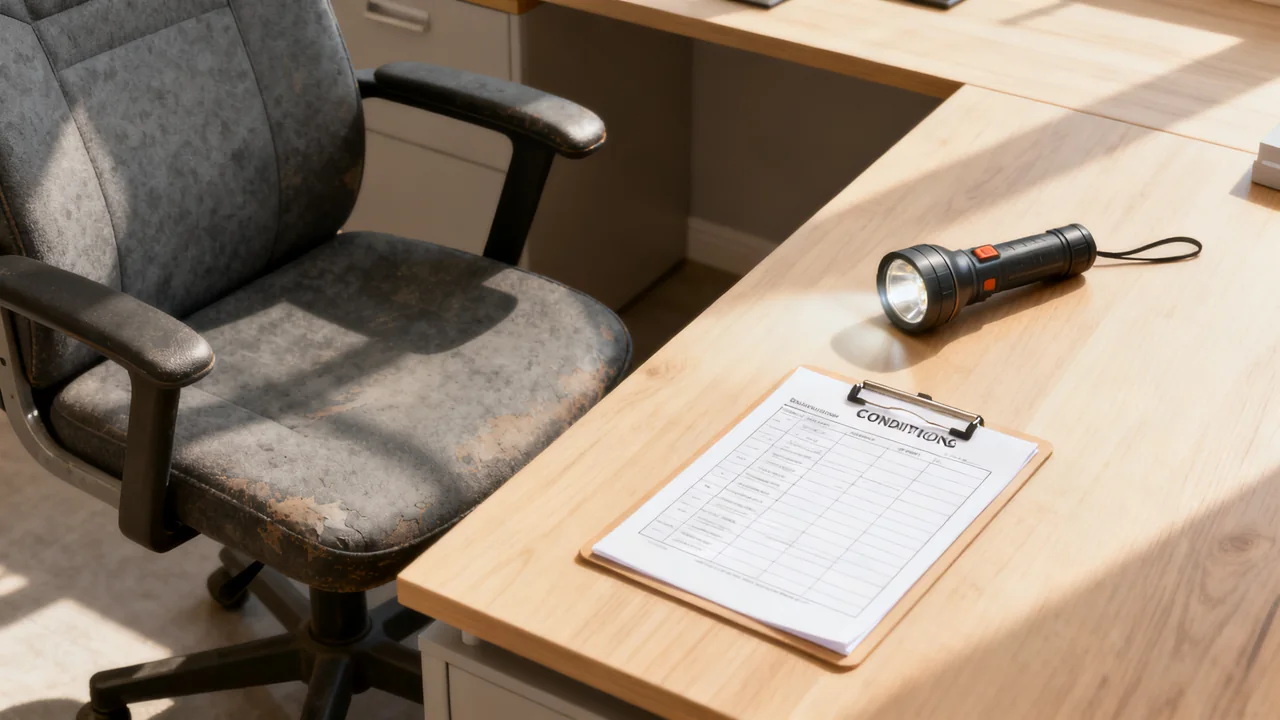
For upholstered seating and fabric panels: Check for rips, tears, or stretched fabric that cannot be repaired without reupholstering. Press firmly into cushions to check for uneven sagging that indicates broken internal foam or webbing. Look for discoloration or odors that suggest mold, mildew, or smoke exposure, which may not be removable even with professional cleaning. For shared seating, confirm the upholstery material is compatible with your workplace’s approved sanitizing products to avoid damaging the fabric during routine cleaning. Avoid pieces with stains of unknown origin, as they may require specialized cleaning that adds significant cost to your purchase.
For mesh seating: Check for frayed edges, snags, or stretched mesh that no longer supports body weight evenly. Ask whether damaged mesh can be replaced with an approved component and include that cost in the decision. Do not infer remaining life from the size of a snag.
Moving Part and Accessory Function Check
Used furniture often has missing or worn small components that are expensive to replace individually. Test every moving part and accessory to confirm it works as intended:
- For sit-stand desks: After checking condition and correct assembly, ask for a normal operating demonstration with clear space and the controls used as instructed. Stop if movement is erratic or there are signs of damage. Confirm the height memory settings (if present) work correctly. Check that the cable management trays, keyboard trays, and any included monitor arm mounts are securely attached and have no missing hardware. If the desk has a manual hand crank, test that it turns easily without jamming.
- For chairs: Confirm all casters roll smoothly on the type of flooring in your workplace, and no casters are missing or stuck. Test all armrest adjustability (height, width, pivot) to confirm they lock in place securely. If the chair has a headrest, adjust it to multiple positions to confirm it stays in place without slipping.
- For storage: Confirm all drawer handles, hinges, and drawer slides are intact. If the cabinet has adjustable shelves, check that the shelf clips are present and that shelves stay securely in place when weight is applied. For rolling storage units, test the casters and confirm the locking brake holds the unit in place when engaged.
If small hardware like screws, clips, or keys are missing, check that replacement parts are available for the specific model before purchasing. Some discontinued furniture models have no available replacement parts, making even minor missing components a dealbreaker.
Illustrative Example: Evaluating a Used Sit-Stand Desk Purchase
This hypothetical scenario demonstrates how to apply the checklist to a real purchase decision:
A small office manager finds a used 60-inch wide sit-stand desk listed locally. First, they confirm the model number from the label on the desk frame, and pull the manufacturer’s spec sheet to confirm the weight rating is sufficient for the team’s dual-monitor setups. During in-person inspection:
- Structural check: The visible frame has no obvious damage, and the top appears even. The manager checks the identified model’s documentation and recognizes that this observation does not prove the structure’s capacity.
- Surface check: The laminate top has two 1-inch long scratches on the left edge that do not penetrate through the finish, and no water damage or warping. The manager notes these scratches are purely cosmetic and will not impact use.
- Moving parts check: The desk runs smoothly through its full height range with no grinding noises, and the memory settings work correctly. The included cable management tray is attached, but two of the four screw clips holding it to the frame are missing. The manager confirms replacement clips are available directly from the manufacturer for a low cost.
The manager weighs the cost of the desk plus replacement clips against the cost of a new equivalent desk, and decides the used option is a good value. They also note that the manufacturer’s care instructions identify the cleaning products and methods permitted for that finish.
Condition vs. Cost Decision Framework
Use this table to weigh condition flaws against the cost of repair or replacement, to decide if a used piece is worth purchasing:
| Flaw Type | Repair/Corrective Action | Purchase Recommendation |
|---|---|---|
| Purely cosmetic (minor scuffs, surface scratches that don’t penetrate finish) | No repair needed, or low-cost touch-up marker for hard surfaces | Purchase if price is below your budget for equivalent used pieces |
| Minor functional (missing replaceable hardware, easily cleanable upholstery stains) | Order replacement parts, schedule professional cleaning | Purchase only if total cost (purchase + repair) is materially below the cost of a new equivalent piece, per your workplace’s budget thresholds |
| Major functional (cracked frame, sagging work surface, frayed mesh, broken motor) | Requires full component replacement or reupholstery, which may cost more than the piece itself | Do not purchase, regardless of discount |
| Sanitation risk (mold, mildew, unknown stains, smoke odors) | Professional deep cleaning, which may not fully remove the hazard | Do not purchase for shared workspaces, even if cleaning cost is low |
Post-Purchase Acceptance Check
Even if you inspected the piece before purchase, conduct a second check immediately upon delivery to catch any damage that occurred during transport:
- Confirm all structural components are still intact, with no new dents, cracks, or bending from moving.
- Re-test all moving parts (height adjustment, drawers, locks) to confirm they still work as they did during your initial inspection.
- Check for new scratches, stains, or tears on surfaces and upholstery that were not present during your first check.
- Confirm all agreed-upon accessories (keys, hardware, monitor mounts) are included with the delivery.
If you find new damage during delivery acceptance, you can negotiate a partial refund with the seller or refuse the delivery entirely, depending on your pre-purchase agreement.
Final Actionable Pre-Purchase Checklist
Use this short checklist to guide every used furniture inspection:
- Confirm the furniture model and pull manufacturer specs to verify original features and part availability
- Complete full structural check for cracks, rust, sagging, or wobble that impacts load capacity
- Evaluate all surfaces for functional damage (penetrating scratches, water damage, frayed fabric)
- Test every moving part and accessory to confirm full functionality
- Calculate total cost (purchase + repair/cleaning) and compare to new equivalent cost to confirm savings align with your budget goals
- Align purchase with workplace sanitation and safety policies for used items
Your final decision will depend on your team’s specific needs: a purely cosmetic scratch may be acceptable for a back-office storage cabinet, but not for a client-facing reception desk. For pieces that will see heavy daily use, prioritize structural integrity and functional components over low cost, to avoid frequent replacements that erase initial savings over time.
Have a question or a correction?
Contact the editorial team