Chair casters affect how a chair moves, how it interacts with the floor, and whether the complete seating system behaves as intended. A replacement that fits the socket is not automatically suitable. Start with the chair manufacturer’s approved options and the floor supplier’s guidance, then evaluate the actual combination.
Identify the chair and its approved replacement options
Record the full chair model, current caster specification if known, and the reason for considering a change. Common concerns include difficult movement, unwanted rolling, noise, visible marks, or damage to a wheel. Each deserves investigation rather than an automatic switch to a popular aftermarket design.
Ask for approved caster or glide options for that chair. Attachment dimensions, retention design, wheel height, load, braking behavior, and base compatibility can matter. Do not rely on a product described as “universal” or infer compatibility from a photograph.
Use the manufacturer’s inspection and replacement instructions and an appropriate person for the work. Do not tip and dismantle a chair by a generic method if its construction or safe handling is uncertain. Keep a damaged or unstable chair out of use until it is assessed.
Describe the floor precisely
Identify the actual floor product and finish where possible, not only a broad label such as wood, vinyl, carpet, or tile. Protective finishes, carpet construction, underlay, seams, and existing mats can change the relevant guidance.
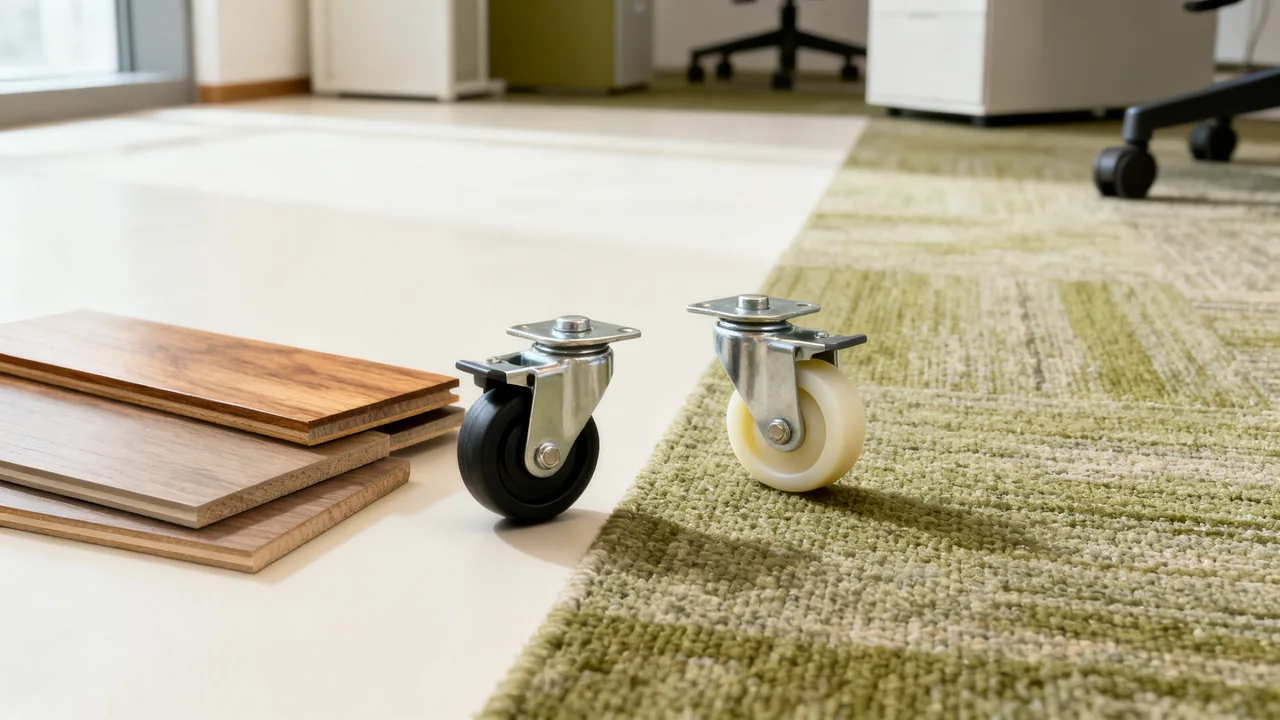
Check both chair and floor documentation for compatible wheels or protection. Hard-floor and carpet caster labels are useful starting points, but they do not establish that every wheel in the category works on every surface. “Non-marking” also does not promise protection from trapped grit or every type of wear.
If chairs move between different surfaces, list the entire route. A wheel that behaves well at the desk may roll differently at a threshold or on a smooth meeting-room floor. Avoid selecting for one area while ignoring another regularly used area.
| Observed issue | What to investigate | What not to assume |
|---|---|---|
| Marks on a hard surface | Wheel approval, debris, floor finish, and protection guidance | Any soft wheel eliminates all damage |
| Difficult movement on carpet | Approved caster options, carpet construction, and suitable mat | A larger wheel always solves it |
| Unwanted rolling | Chair’s intended braking or glide arrangement | Maximum rolling freedom is always desirable |
| Noise | Wheel condition, debris, floor joints, and approved alternatives | A bearing label guarantees a quiet result |
| Mixed surfaces | Behavior through the actual permitted route | One successful spot test covers every area |
Keep the complete chair rating intact
Do not calculate a chair’s safe capacity by multiplying a caster’s individual rating by the number of wheels. Loads are not necessarily shared equally during movement, and the chair base and other components have their own requirements. Use a replacement approved for the complete chair and intended use.
Wheel diameter and assembly height can change the chair’s effective seat height and movement. Verify that the resulting chair still fits the workstation and behaves as intended. More substantial-looking wheels are not automatically a safe upgrade.
Brakes, load-sensitive behavior, and glides may be part of a specific chair design. Ask the manufacturer how an option operates when occupied and unoccupied. Do not add a generic locking wheel to solve a stability concern without checking the system.
Evaluate floor protection and housekeeping together
A suitable chair mat or other approved protection may be appropriate for a particular floor. Check compatibility with the floor, chair, and user, including edges, transitions, and stability. A mat is not a substitute for repairing a damaged floor or an unsuitable wheel.
Keep ordinary debris out of the movement area through the floor’s approved cleaning routine. Inspect the wheels for accumulated material according to the chair instructions. Do not encourage chairs to roll over paper clips or other debris as a performance test.
Use only approved cleaning and maintenance methods for the wheels. Avoid unapproved lubricants or solvents, which can affect materials, attract dirt, or reach the floor. If debris cannot be removed safely through the documented user procedure, arrange service.
Run an illustrative mixed-floor review
Assume an imaginary office uses the same chair model on carpeted work areas and a hard-floor meeting room. Staff report difficult movement on the carpet and marks near a meeting table. These are scenario observations, not evidence that the current caster material is the sole cause.
The office checks the chair’s approved options and both floor specifications. It inspects the wheels and floor for debris or damage, then arranges a trial of a compatible option if one is recommended. The trial checks seated access to the desk, controlled movement, transitions, and behavior in the meeting room.
If no approved option suits both areas, separate chair allocations or an appropriate floor-protection arrangement may be preferable. The trial can support that local decision; it cannot demonstrate a universal reduction in damage or predict years of wheel life.
Document replacement and review real use
Record the approved part code, chair model, floor application, and who completed the replacement. Verify the finished chair using the manufacturer’s acceptance checks. Do not mix different wheel configurations on one chair unless explicitly supported.
Tell users where to report unwanted movement, instability, visible damage, or a changing seat height. Recheck after a representative period and when floor coverings or desk layouts change. Keep replacement parts traceable so a later repair does not undo the approved configuration.
- Identify the exact chair and floor products.
- Use approved replacement options and installation procedures.
- Check complete-system ratings and resulting height.
- Evaluate brakes, movement, transitions, and floor protection.
- Maintain wheels and floors using their specific instructions.
- Remove damaged or unstable chairs from use pending service.
Have a question or a correction?
Contact the editorial team