A useful supply cupboard lets someone answer three questions without a search: what belongs here, what is available, and what needs attention. The aim is visible, dependable stock, rather than fitting the largest possible quantity behind the doors.
Begin with the cupboard you have and the people who use it. Shelf capacity, stable installation, comfortable access, and each product’s storage instructions take priority over a tidy photograph. A layout that hides heavy cartons above people’s heads is not an improvement.
Take stock before choosing a layout
Group supplies by exact type and compatibility. Similar-looking printer cartridges, label rolls, or refills may not be interchangeable. Keep their identifying packaging and separate items whose differences are easy to miss. Put unidentified or damaged stock aside for the responsible person to assess rather than placing it among ready-to-use supplies.
Record all locations, including spare cupboards and desk drawers used for communal stock. Otherwise, an empty shelf can trigger another order even when a full carton is elsewhere. Decide which location is the main record and label any reserve location clearly.
Combine access frequency with weight and reach
Put frequently used, manageable items where the regular users can see and reach them comfortably. Test access with the people who will use the cupboard; one nominal shelf height will not suit everyone. Do not let frequency override the need to keep heavier loads in suitable, stable positions.
Reserve high or awkward shelves for suitable light items that are rarely needed, provided they can be retrieved safely. Follow the cupboard maker’s load and installation guidance. If safe access is impractical, reduce the stored quantity or find a better location rather than treating the upper shelf as unlimited overflow space.
Keep products that can leak separate from paper and electronics. Follow their own storage and segregation instructions. Cleaning products should not share a bin with food, and decanting supplies into unmarked containers makes identification harder.
Give each item a defined home
Choose shelf positions or bins that suit the actual pack dimensions. Leave enough room to grasp and remove a full pack without disturbing unrelated supplies. A removable divider can stop two similar products merging, while a shelf-edge label remains visible when the stock is gone.
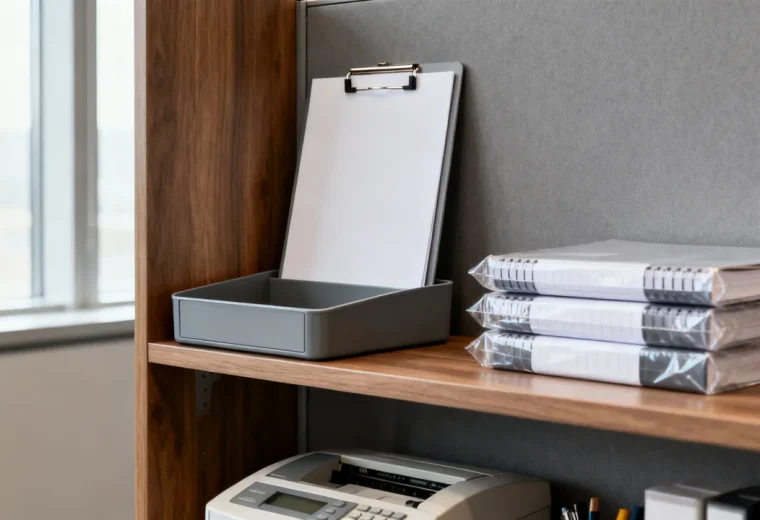
For small loose supplies, try an open bin with a front low enough to see the contents. A sloping front can improve access, but does not mean clips or pens will automatically move forward. Check the actual container with the items you intend to store.
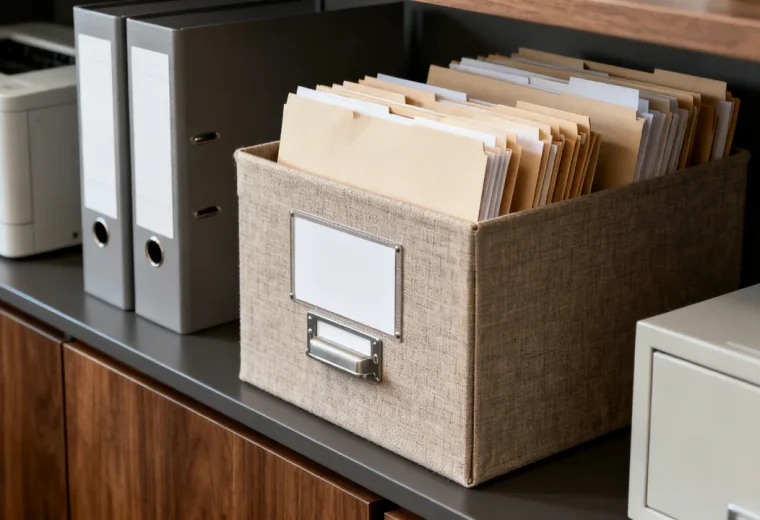
When depth hides stock, keep a front-facing working quantity and a clearly identified reserve behind or elsewhere. Deep storage is workable if its quantity is recorded and checked; it should not be confused with full visibility.
Separate working stock from reserve stock
The working shelf is where colleagues collect supplies. Reserve stock replenishes that shelf. Label both locations and make the distinction clear on any request form. “Refill the pen bin” and “order more pens” are different tasks.
As a hypothetical example, an office keeps an open pen bin beside its paper shelf and unopened pen packs in a labeled reserve box below. When the bin is low, the supply owner checks the reserve before buying. If the reserve reaches the locally chosen reorder point, the owner places an order and records that action. No fixed pack quantity is implied by this example.
This arrangement keeps daily access simple while preserving visibility of the overall stock. If only one location is needed, avoid creating a reserve system merely for its own sake.
Use a request card before the item runs out
A small “needs attention” pocket or a shared digital list can collect low-stock reports. Use a card with the item name and location, rather than moving the last usable item out of circulation. Decide which level should trigger a report based on use and delivery time.
Assign someone to check requests on a schedule suited to the office. Include a clear route for urgent shortages. Once an order is placed, mark the item as ordered with an expected delivery date; otherwise several well-meaning colleagues may submit duplicate requests.
A line on a bin can be a useful visual cue only if the contents are sufficiently consistent for the line to mean something. Mixed pack sizes, loose piles, and partly used containers usually need an actual count.
Keep date-sensitive stock identifiable
For products with a printed expiry or use-by date, make the date visible and arrange suitable stock so the earliest valid date is used first. Receipt order and expiry order are not always identical. Follow any product-specific instructions for unopened and opened stock.
Do not remove original packaging merely to achieve a uniform appearance. Packaging may carry compatibility, storage, batch, or safety information. If a secondary bin hides that information, add an identifying label while retaining the original details with the product.
Choose visibility features for a reason
| Feature | Useful when | Limit to check |
|---|---|---|
| Clear bin | Pack identification is easier through the sides. | Labels still matter, and a glance may not give an accurate count. |
| Open front | Small supplies need frequent access. | The contents need protection from dust or accidental spills. |
| Lidded reserve box | Infrequent stock benefits from containment. | The label and count must be maintained. |
| Divider or marked shelf space | Neighboring items are easily mixed. | The space must fit the current packaging. |
Check the layout in use
Ask a colleague who did not arrange the cupboard to find an item, identify its reserve, and report a low level. Watch for hidden labels, awkward reaches, and names that make sense only to the buyer. Adjust these before purchasing a complete set of matching containers.
- Confirm safe shelf capacity and access.
- Label the location as well as the container.
- Distinguish replenishing a shelf from buying more stock.
- Keep compatibility and storage information with the product.
- Review recurring shortages and duplicate purchases with the supply owner.
Have a question or a correction?
Contact the editorial team