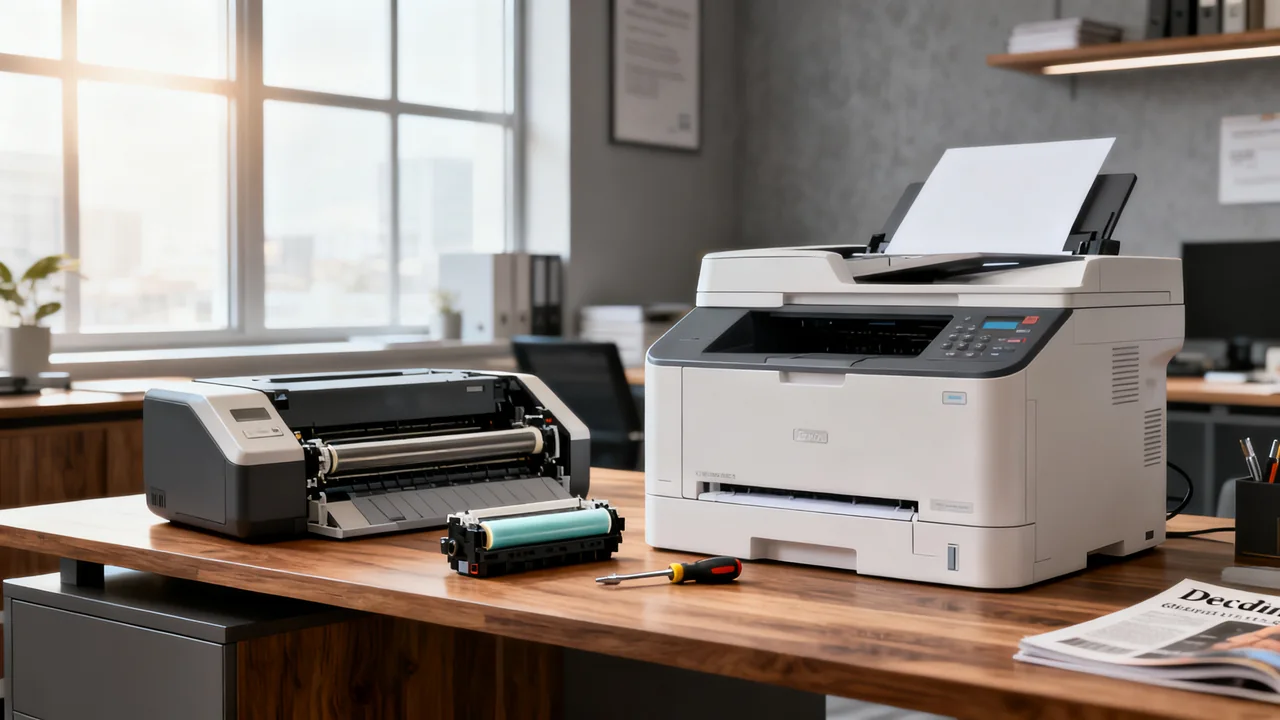
A printer service agreement should make it clear what help you are buying, when it is available, what remains your responsibility, and how the charges can change. A low monthly fee is difficult to evaluate without those details. Build a comparison sheet from the actual offers rather than assuming that “full service” means the same thing to every supplier.
Identify the equipment and the scope of coverage
Record the printer model, serial number where available, installed options, service location, and covered functions. For an all-in-one device, confirm whether scanning and feeding faults are included alongside printing. Accessories and connected software may have separate terms.
Separate labor, travel, parts, consumables, preventive visits, and remote support. Ask about items that may be replaced separately, such as drums, maintenance units, rollers, and waste containers, as applicable to the exact model. A toner-inclusive plan is not automatically a parts-inclusive plan.
List exclusions in the comparison sheet. Ask how the supplier treats unsupported media, damage, unauthorized repair, network problems, and consumables from other sources. Record the written term rather than assuming an exclusion either applies universally or cancels every part of the agreement.
Distinguish acknowledgment, response, and restoration
A promised response may mean an acknowledgment, remote contact, dispatch, or arrival. It does not necessarily mean the printer will be working again within that time. Ask the supplier to define the event that starts the clock and the event that satisfies the commitment.
Check service hours, holidays, geographic coverage, and how tickets must be submitted. Ask what happens if parts are unavailable or a fault requires workshop repair. A loan device or external-printing arrangement can matter more than a short initial response for a deadline-sensitive job.
If an uptime commitment appears in the offer, read how it is measured, which hours and outages count, and what remedy is available. Do not turn a monthly or annual percentage into a guaranteed maximum outage for each individual week. The measurement period and exclusions are part of the promise.
Map the charges to your actual usage
Identify fixed charges, included page allowances if any, overage rates, minimum billing, supply shipping, optional features, and scheduled increases. Not every service agreement uses a page allowance. Compare the specific structure in each quote.
Where pages affect billing, confirm the unit and the treatment of color, duplex output, paper sizes, copies, and device test pages. Ask whether unused allowances expire or carry forward and whether they can be shared across devices. Keep this information separate from the printer’s rated workload.
Use representative past usage and known seasonal changes to calculate several scenarios. A fixed fee may be attractive for one workload and less so for another. Do not assume the premium option becomes economical at a generic page count; the result depends on the actual prices and included services.
| Agreement area | Question for the supplier | Evidence to retain |
|---|---|---|
| Covered equipment | Which functions and installed options are included? | Equipment schedule or written scope |
| Support timing | What starts and stops the response clock? | Definitions, service hours, and reporting method |
| Parts and supplies | What is included and what is billed separately? | Coverage and exclusion list |
| Downtime | What happens while repair is unresolved? | Loan, escalation, and remedy terms |
| Changing requirements | What happens on relocation or device replacement? | Transfer, substitution, and termination provisions |
Use an illustrative deadline scenario
Assume an imaginary team must produce a client pack each Friday. Offer A costs $110 per month and promises next-business-day contact during its stated hours. Offer B costs $165 and promises an on-site response within a defined service window. These amounts and terms are illustrative assumptions, not market quotations.
The monthly difference is $55. Over 36 months, before any adjustments, that difference totals $1,980. This arithmetic alone does not establish that Offer B is worthwhile. Neither assumed term tells the team when a repair will be complete or whether a replacement is provided.
The team therefore asks both suppliers what happens after a Thursday failure, whether parts delays change the commitment, and how an unresolved incident is escalated. It also obtains its own fallback printing arrangement. The decision can then compare the actual service difference with the premium and the importance of the deadline, without inventing the cost of a hypothetical emergency.
Check term dates and change procedures
Record the start date, end date, renewal mechanism, notice process, and any price-review dates. If a lease, purchase finance arrangement, software subscription, and service contract are separate, compare their dates and obligations. Do not assume ending one automatically ends the others.
Ask what happens if the office moves, replaces the printer, changes volume, or closes a location. Identify any transfer conditions, early-ending charges, return obligations, and data-handling steps. A supplier’s verbal assurance should be reflected in the relevant written documents.
Enter notice dates and responsible owners in the office calendar after signing. For an unclear or significant contractual obligation, obtain appropriate advice rather than relying on a purchasing checklist to interpret legal rights.
Confirm responsibilities and the service workflow
Agree who orders supplies, receives deliveries, reports faults, approves chargeable work, and provides access. Clarify which user maintenance tasks are expected and ensure they are within the device’s instructions and staff capability. A service agreement should not become a reason for untrained staff to open electrical assemblies or perform unsupported repairs.
For remote support, determine what access is needed and who authorizes it. Check how device credentials, usage records, and stored job information are handled under the organization’s policies. Do not assume a service provider needs unrestricted access to every office system.
- Attach written answers and exclusions to the quote comparison.
- Compare restoration options as well as initial response.
- Calculate costs using the same workload and term.
- Check renewal, relocation, replacement, and ending procedures.
- Assign an internal service owner and backup.
- Review the first service incident against the agreed process.
Have a question or a correction?
Contact the editorial team